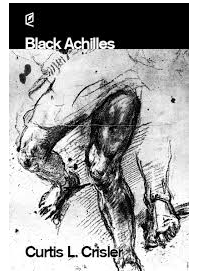
Tell us the story of your Accents Publishing book, BLACK ACHILLES. What do you like most about it?
What I adore most about Black Achilles is my collaboration with Katerina Stoykova and Accents Publishing editors and staff. Through collaboration, we achieved a poetic rendering of me severing my Achilles. By facilitating collaboration and community of the artwork, cover pages, and layout, we achieved one of my best-looking and formatted books I have to date.
What did you have to overcome in order to finish and publish the book?
Black Achilles came about when I tore my Achilles playing basketball for our university’s
Homecoming Week. It was the Faculty vs. the Students. I was on the faculty. Everything went well through warmups. Then, when the game started, I ran up and down the court a couple of times before I heard what sounded like a gunshot. The body is an echo-chamber. I looked around to see if anyone else had heard it. No one did. Then, I tried to walk. My left foot flopped like a fish on dry land. One of my teammates’ husband observed me since he severed his. He told me that it was my Achilles by feeling the divot in my leg. I didn’t want to believe it, but I tore mine.
I would later have surgery—be in a cast, then shoe, then knee-cart to teach and be mobile. It was Christmastime. I laid on my back, left leg elevated on couch back, while my mother helped me convalesce. This book was about a man who felt he lost his demigod status for b-ball (alludes to Achilles). He fell to human—left with the troubles of inconvenience and frustration. The poems play in myth and realism—with each breath and rehabilitative step for mobility and functionality to rise back or at least return to a sliver of demigod. The collaboration to get the book to where it needed to be, along with rehabilitation, were two trains on two different tracks, near touching—one went east, the other west. To solve the equation for a black broken body—nebulous.
What do you hope people learn/receive/experience from reading your book?
I really enjoy the feedback I get from the book. Those who deal with body issues (disability and pain), functionality, along with identity, health, mental stability, and the two worlds that split you apart: past/future, now/then, and me/who, conflate themselves to a searching. Searching for who and what you will become from the ruins of the broken—the old body that has changed into a new body. You wonder if you will heal, or not. You think of those born with disabilities, those who become disabled, and those who never see either. Humanity stands alone. This was a reason for Kim Addonizio’s epigraph, “the wheelchairs hate the shoes,” from “The Way of the World.”
So, I played with the personification of inconvenience and frustration. I became Doc
Octopus—Spider-Man’s nemesis—a Marvel villain. This came about because I wasn’t functional per usual after surgery. One time I got up off the couch and tried to walk, only to face-plant on the floor, on a comfortable rug. Below—a few excerpts of how inconvenience and frustration and Doc Octopus took over my life, my mind, and my psyche.
Overseer
Inconvenience puts his arms around me. This hug
weighs world-winds and begs like infidelity’s lip-
stick marks. He wants me to learn how to fall again.
There’s no sophistication to hitting the ground. I do…
Or, how this barrage of doubt with the impending placement of inconvenience and frustration or Doc Octopus domesticated my mind, had me reeling in my rehabilitation. The good about it all, it gave me concepts on how to create and explore on the page. The above reveals itself in two more excerpts from Black Achilles, the first from “There’s This…”—
Scarred. There’s the little stalls, the reaching for
the soap while on two new metal appendages.
How basic science can hold you up. As Doctor
Octavius you have one flat tire—one appendage
disengaged—you can do nothing in your mania
to stop Spidey. Scarred. The stress of another fail.
The second, as follows:
Date night
Frustration and inconvenience crash “last call for alcohol,”
as if someone cried out, “is there a doctor in the house?”
As if they were both doctors. Frustration brings inconvenience
home. You hear their rattling bodies going at it in the kitchen.
You hear their angry love making cry out like stuck mad dogs.
You hear them snore like grizzly things.
What was your favorite interaction with a reader and/or a fan?
I guess the ultimate interaction would be with professors, lecturers, teachers, and poets/writers who enjoyed the book and used it in their curriculums or workshops. It’s there where questions arose about my poetics and creativity surrounding the book. It’s great to express how real-life situations can proliferate into a creative kaleidoscope of poetic endeavor. Also, to share the origin story of the book with those interested—priceless. It’s in that space where we can blossom. All interactions afterward are blessings!
What are you working on now? Catch us up on one significant event in your life since the publication of BLACK ACHILLES.
Currently, I am beginning my second term as Indiana’s Poet Laureate. It’s very fulfilling and arduous, simultaneously, but I enjoy bringing Hoosiers together via poetry. For the page, I am putting together a tentative manuscript called Imaginate. The word, “Imaginate,” came from an Eric B. & Rakim song called, “I Ain’t No Joke.” I’m trying to figure out if it will be a hybrid book, a poetry book, or a poetry book and a poetry chapbook. Still processing…
Is there anything you want to get off your chest about writing or publishing?
Writing is one of the best creative endeavors to address who and why we are us. We need more great writers. We need great publishers to publish great writers. We need more great humans too.