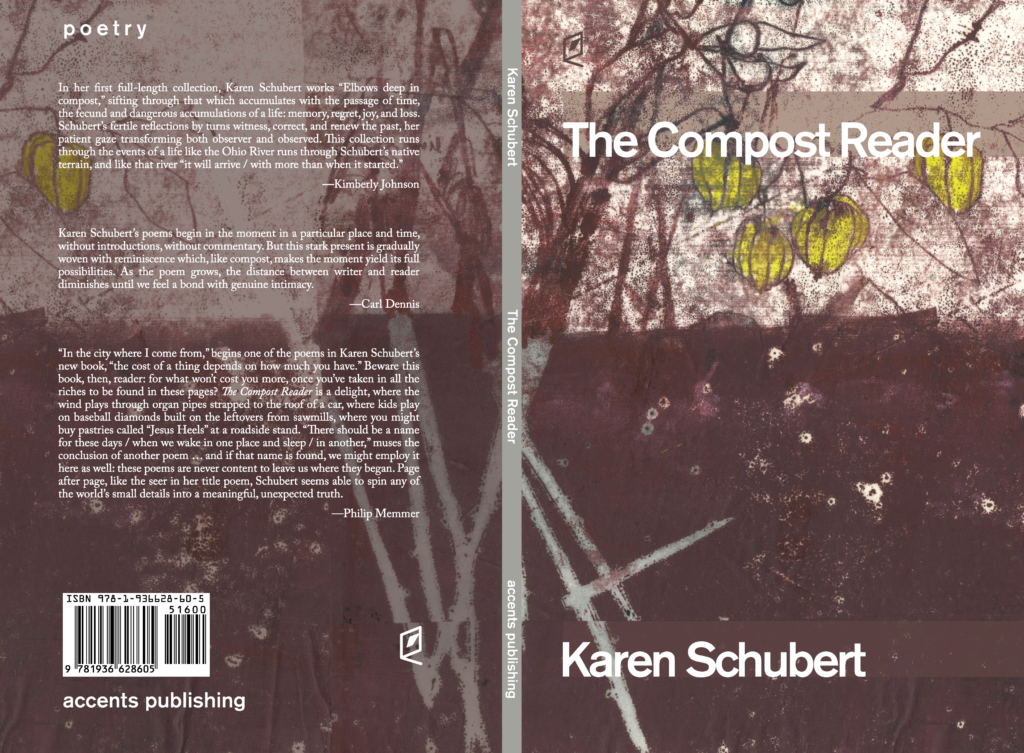
Tell us the story of your Accents Publishing book, The Compost Reader.
The first iteration of this manuscript was my MFA thesis, with the working title In This Light. I sent it out to a round of contests, and later exchanged manuscripts with some poets I admire. Barbara Sabol, such a generous and astute reader, noted that the “I”; in the manuscript made shifts that were disorienting. I re-edited the collection, rewriting some poems in 3rd person. Where characters recur, I arranged poems in chronological order and infilled with non-biographical poems.
Meanwhile, my concept chapbook manuscript I Left My Wings on a Chair won the Wick Poetry Center chapbook prize, and that led me to believe that surreal prose poems were a strong suit. Left to my own devices, my poems are oh so earnest, very sigh, and I think it was a memetic workshop in grad school that led me to the joy of trying out many voices, getting at an idea by building a weird world around it. I love the work of Mark Levine, Nin Andrews, Mathias Svalina, so many. I rearranged the manuscript again and centered those poems. For example the title poem, “The Compost Reader”; imagines a professional seer you can hire who will open your compost bin and tell you deep truths about yourself. Gah, so fun to write.
I sent the manuscript out again and was finalist at presses I wildly admire like The Word Works and Two Sylvias Press, what a thrill. Meanwhile, I reconnected with Katerina, whom I met some years ago at AWP, and she asked me what I was working on. I sent the manuscript to her and was over the moon when she said yes. I love Accents Publishing and the important work Katerina is doing in contemporary letters.
Surreally, the book came out during the pandemic lockdown, and that led me to realize there was a need for an online reading series for new books that were coming out in that moment. So with Nin Andrews, Lit Youngstown ran the New Book News series, readings that are archived on Lit Youngstown’s YouTube channel. What an honor, and I have since been able to invite some of those amazing authors to Youngstown.
What do you like most about it?
What I like most, from this vantage, is that the manuscript was not accepted until it had a more completed shape and narrative arc. I don’t remember who calls this editing in public, something like that. Not my intention. Each time I sent it out, it seemed finished, but somehow, when an editor doesn’t select a poem or manuscript, I can see it in a fresh way. Katerina as an editor has a sharp eye and made terrific suggestions, and I also found a few sloshy spots and she was generous about allowing me to continue making changes right up to the final final final. That was what I was really hoping for with my first book, that I’d find an editor who really cared about the work.
And allowing me to select my cover artwork was absolute joyful gravy. I had been in residence at the Vermont Studio Center with the stunningly talented printmaker Mary Gordon McFall, and Mary graciously said yes to her artwork on the cover. I love the rich ground of the image, and it’s no surprise Mary lives on the Kansas prairie and brings an eye to the depth of growth and regrowth.
What did you have to overcome in order to finish and publish a book?
The years I spent editing and submitting I was teaching as an adjunct and then working in cafés while building Lit Youngstown, so a submission fee represented a substantial expense. I would budget one submission fee per paycheck. And the around-the-clock nature of teaching and non-profit administration makes it hard to set aside quiet head space for the work of writing.
What do you hope people learn/receive/experience from reading your book?
Life is such a wild ride, I hope someone reading my book spends a moment in their own wild ride stories, and in that way of fellow travelers, we connect.
What was your favorite interaction with a reader and/or a fan?
I was invited onto an AWP panel of first book publishing over the age of 50. I was floored when, after the panel, there was a line of people waiting to talk to me, and they bought all of the books I brought. I love that inclusive nature of writing, the way experience and perspective serve us, rather than sideline us, those who are lucky enough to have more years to live and write.
What are you working on now? Catch us up one significant event in your life since the publication of The Compost Reader.
I am working with some artists on a new initiative, LOOP Youngstown Arts + Culture, and we are under contract for a building! In addition to dozens of artist studios and support for artists, there will be space for arts nonprofits like Lit Youngstown to work and grow in an arts-rich environment. These kinds of centers are happening everywhere, but this will be Youngstown’s first, and I’m chuffed.
Optional bonus question: Is there anything you want to get off your chest about writing or publishing?
Occasionally I’ll hear someone say that no one reads any more and wow, that’s not what I see. In 10 years, Lit Youngstown has hosted thousands of writers and people who may not consider themselves writers, who spent time with us engaged in and sharing creative work. I love this literary community, how expansive the curiosity. We’re wired to feel heard, and I’m here for it.