Metes and Bounds (Accents Publishing, 2010)

Poet J. Kates answers a few questions about Metes and Bounds (Accents Publishing, 2010)
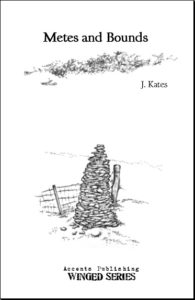


Tell us the story of your Accents Publishing book.

Not sure there is a story to tell. I had written some poems, they seemed to fit together in theme, there was a chapbook contest from Accents Publishing, and I submitted to it. You liked it, apparently.


Do you still like it? Why or why not?

The poems I write that stand the editorial test of time long enough to make it to publication are poems I like. The rest, I throw away.


What is the highest praise you’ve received for it?

Not sure I’ve received any “praise” for Metes and Bounds. You published it, some people have bought it. That’s praise. Can’t recall if it was ever reviewed.


What didn’t make it in the book?

Most of the poems I’ve written in my life. Luckily, a good many have made it into other books, with, I hope, more still to come.


Is there a poem from the book you’d like to share with the readers of the Accents blog?

I’d like to have your readers read them all. That’s why I wrote them. If it’s your blog, you choose.


Selected by Katerina and inserted in the text:

DOING THE WORMS’ WORK

The first April I am certain I will die,
the ground too cold, too wet for planting,
the river only a foot down from flood,
the compost heap a contradance of bees,
I need to be looking toward a harvest.

I will turn dirt. Without stooping
to pick rocks, I do the worms’ work
for an hour or two, see how I like it,
see how I enjoy the company of worms.
Not bad, they say, not bad for a beginner .


How did you arrive at the title?

Ah, there’s an interesting question. In New England, where I live, it has long been customary to establish boundaries not by formal surveying, but by noting and describing landmarks (or by creating them, as with walls and cairns). All the poems in this little collection somehow have to do with limits and limitations, and there is a rural cast to them; it seemed an appropriate title. I have worried, since, however, that the title sounds a little too bucolic, characterizing my work (unfairly, I hope) as “when the Frost is on the bumpkin.” Perhaps that’s balanced by the cosmopolitanism of an earlier chapbook (Mappemonde, Oyster River Press) and by other published poems.


Do you have a favorite Accents Publishing book (other than yours) and if so, which one?

Partial to anthologies and to translation as I am, you can guess I’d single out The Season of Delicate Hunger, for its introduction and presentation of contemporary Bulgarian poets.


What would you like to see Accents do going forward?

Succeed. On your own terms.


What are you working on now?

I have two full-length manuscripts being widely rejected. I continue to write — including some experimental, urban prose poems — and to translate.


Share a poem, or at least a sentence from your new writing.

“The human in me knows how to retreat.”
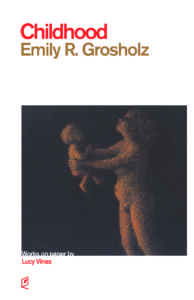
Childhood (Accents Publishing, 2014)

Poet Emily Grosholz answers a few questions about Childhood (Accents Publishing, 2014)

Tell us the story of your Accents Publishing book.

I wanted to create a book with my poems about small children (my four children when they were small) to support UNICEF. I’ve been a supporter of UNICEF for thirty years, since my first child was born. I had a friend in Paris, Lucy Vines, who drew lovely pictures of small children, so I lobbied her for a year to collaborate with me, and finally she agreed. Just at the same time, I met Katerina and realized that Accents Publishing was a promising place for this book, and she too agreed! We have raised over $3500 for UNICEF since Childhood was launched in 2014.


Do you still like it? Why or why not?

My affection for this book grows with every passing year.


What is the highest praise you’ve received for it?

The highest praise for this book is the different ways in which it has been translated. It has been translated into Japanese, Italian, French and German, and now Katerina is translating it into Bulgarian. And some parts of it have also been ‘translated’ into songs, by Mirco De Stefani in his CD Childhood Songs, Koko Tanikawa in her CD First Piano Lessons, and by Bruce Trinkley in his CD Songs of Two Bellevilles. This fall, when we were working in Rome, my husband and I went up to Venice for a concert at a wonderful villa just north of the city. We were joined by Mirco and his wife, and the soprano Cristina Nadel sang and the pianist Igor Cognolato played the Childhood Songs to a warm and enthusiastic crowd. I just got the poster framed, to remember one of the happiest days of my life.


What didn’t make it in the book?

I couldn’t put in my poems about mathematics and science, but they do show up in other books, and in Great Circles: The Transits of Mathematics and Poetry, which helped to launch a new series of Springer Books about Mathematics, Culture and the Arts in 2018. Oddly, five of the poems in Childhood also show up there in Chapter 4.


Is there a poem from the book you’d like to share with the readers of the Accents blog?

Here is the poem that got turned into a song twice! This poem is dedicated not only to all my children, but also to their piano teacher, Leslie Beers, who taught them both piano and violin over so many years. (In Great Circles, in Chapter 7, I argue that music is the middle term between poetry and mathematics.)


First Piano Lesson

For years they have been pressing the white keys,
Sometimes the black, occasionally, haphazardly
Great fingerfuls together. But where
Exactly was the music, they wondered? Gone.

Today they built a bridge from C to G
As if across Giverny’s garden pond.
Perhaps it is a rainbow? G to C,
Aural, slant-visible, inevitable, clear.

They stand amazed around the grand piano
Capable at last of lifting up
From sound’s long restlessness the dripping
Glittery net of intervals and in its knotted strings

That golden fish, a song!


How did you arrive at the title?

The book included all my poems about childhood (from the perspective of a parent), from conception to the day when the children leave to make their own way in the world.


Do you have a favorite Accents Publishing book (other than yours) and if so, which one?

I have two favorites. One is The Season of Delicate Hunger: Anthology of Contemporary Bulgarian Poetry, edited by Katerina. It introduced me to the life of that country in the last century or so, in abstract and concrete ways as poetry does. And my interest is now intensified by my reading, during the past decade, many books about the Black Sea, and also by the prospect of the Bulgarian translation of Childhood: I hope to turn that poetic experience into a real visit. My other favorite book is Circe’s Lament: Anthology of Wild Women Poetry, edited by Katerina and Bianca Lynne Spriggs. I remember intending to send some poems in to be considered for that collection, but somehow I missed the deadline, and was sorry about that: I do have some wild woman poems and I like the category. However, getting the book and reading through it is a consolation, inspiration and fun, because of the way it combines myth and modern life, transforming both.


What would you like to see Accents do going forward?

Keep on publishing good poetry and thoughtful translations; and I think creating the related journal Literary Accents was a very good idea. How about publishing collections of literary essays?


What are you working on now?

I’m on sabbatical, working with one of my brothers who is a marine biologist in California and a friend from high school who became a population geneticist in Minnesota: I’m using their work (and political engagement) as case studies for a book on philosophy of biology and practical deliberation. Visiting their field sites on Tomales Bay, Bodega Bay and San Francisco Bay, and then all across the state of Minnesota, inspired quite a few poems, not surprisingly. Two months in Rome also inspired a few poems, and cosmology and number theory are still giving rise to the odd poem.


Share a poem, or at least a sentence from your new writing.

Here’s the beginning of one of my Rome poems: wherever you go in that city, you find a poem lurking behind a church or piazza or small forest of umbrella pines! Or the banks of the Tiber!


The bougainvillea blossoms lightly fall
Across the pavement and desert the trees.
The pomegranates splatter on the grass
And sidewalks, and disturb the sailing green
Parrots that come from Africa. All through
October those bright flowers and fruits still shone
And breathed their colors on the city streets…

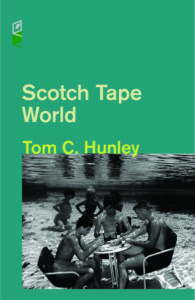
Scotch Tape World (Accents Publishing, 2013)

Poet Tom C. Hunley answers a few questions about Scotch Tape World (Accents Publishing, 2013)

Tell us the story of your Accents Publishing book(s).

After the book came out, I got to do a three city book tour with fellow Accents authors Lynnell Edwards and Eric Sutherland. That was a good time.


Do you still like it? Why or why not?

Most of the time. Sometimes I think I just learned to write poetry and only my new work is any good, though.


What is the highest praise you’ve received for it?

I don’t know. The blurb by Shane McRae is particularly kind.


What didn’t make it in the book?

A sestina about President Obama’s beer summit got cut at the last minute.


Is there a poem from the book you’d like to share with the readers of the Accents blog?

Verse Daily reprinted the title poem. Here it is.

http://www.versedaily.org/2014/scotchtapeworld.shtml


How did you arrive at the title?

Several of the poems are about raising kids and trying to honestly explain the world to them. It just occurred to me that there are striking parallels between this book and Good Bones by Maggie Smith. If you like her book, you might like mine.


Do you have a favorite Accents Publishing book (other than yours) and if so, which one?

I’m torn between Black Achilles by Curtis Crisler and How Swallowtails Become Dragons by Bianca Spriggs.


What would you like to see Accents do going forward?

An offsite AWP reading.


What are you working on now?

My wife and I are raising three sons and a daughter. Our eldest son is on the autistic spectrum, and a lot of my poems are about him. We adopted our daughter from state foster care when she was 16 1/2, and she has a lot of challenges. A lot of my poems are about her. A lot of people don’t know anyone like Evan and Elizabeth, so I’ve been grappling for words to explain who they are.


Share a poem, or at least a sentence from your new writing.

http://heroinchic.weebly.com/blog/pounds-by-tom-c-hunley

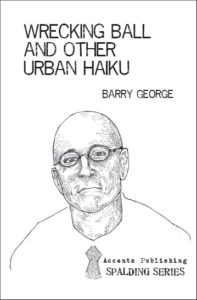
Wrecking Ball and Other Urban Haiku (Accents Publishing, 2010)

Poet Barry George answers questions about Wrecking Ball and Other Urban Haiku (Accents Publishing, 2010)

Tell us the story of your Accents Publishing book(s).

At the time my book, Wrecking Ball and Other Urban Haiku, was published in 2010, I had just graduated from the Brief-Residency MFA program at Spalding University. I had been writing haiku for about fifteen years, and in the two years at Spalding had concentrated on studying and writing haiku, as well as tanka. Katerina Stoykova was a classmate of mine, and her ambition to start Accents coincided with my eagerness to have a book of haiku published. Most of the poems in Wrecking Ball are taken from my Creative Writing Thesis at Spalding. I remember that after assembling the longer thesis (which included haiku, tanka, and longer poems), the selection and ordering of the haiku for Wrecking Ball just kind of fell into place.

Do you still like it? Why or why not?

Yes. I still like the poems and the sequence in which they appear. It was my first chapbook, so it will always have a special meaning for me.

What is the highest praise you’ve received for it?

An important goal of mine is to write poetry that is enjoyed not only by other poets and poetry enthusiasts, but also by folks who don’t generally read contemporary poetry. So what I especially have valued are the comments I’ve received, from various people, that Wrecking Ball is a book they’ve kept close by on the nightstand, or on the coffee table or hair salon counter for themselves and their guests to read.
What didn’t make it in the book?

My only wish is that it could have been longer, that it could have included more poems. But I do like the spare format of only one haiku per page. And I feel fortunate that my Wrecking Ball haiku seemed to be well-suited for the first generation of Accents publications: in-house printed chapbooks sold at a popular price.

Is there a poem from the book you’d like to share with the readers of the Accents blog?

Since haiku are short, I would like to share a pair of them that represent two different stages of a related theme.

after the storm
he is rich in umbrellas—
the homeless man


older
wearing glasses now
the homeless man


How did you arrive at the title?

I wanted to emphasize that this was a collection of urban haiku, poems that adapt the traditional forms of haiku and senryu (haiku-like poems about human nature) to city life. One of the poems is about a “wrecking ball” that “swings in and out of darkness.” Since a wrecking ball is not usually what comes to mind when one thinks about haiku, I thought that image, as a title, would emphasize and draw attention to the somewhat unusual, even iconoclastic, nature of the urban-themed haiku.

Do you have a favorite Accents Publishing book (other than yours) and if so, which one?

I especially like Barbara Sabol’s Original Ruse for its playfulness and the variety of forms Barbara uses to develop different aspects of her theme.

What would you like to see Accents do going forward?

I would like to see Accents, in either its journal or published books, encourage experimentation with writing that considers the ways that our assumptions and perceptions about what it means to be human are, necessarily, changing in light of the climate emergency.

What are you working on now?

First, let me mention that I have something new coming out from Accents Publishing later this year!—a book of haiku called Sirens and Rain, which explores beyond Wrecking Ball the varieties of urban life in Philadelphia. Meanwhile, I am writing the haiku, senryu, and tanka that occur to me on my daily rounds—or, as often as not—in the middle of the night. I am most interested in finding poetic ways not merely to express an observation about “nature” or “human nature” as something separate from “me,” but to embody an intimation of my essential unity with other aspects of creation.
Share a poem, or at least a sentence from your new writing.

A tanka:

this river now
I’m falling through
what surfaces
I once considered
ice

I Am Proud that We Have Persisted and Survived: Interview with Katerina Stoykova

Writer and journalist Alan Lytle interviews Katerina Stoykova about the upcoming 10 year anniversary of Accents Publishing. 

Accents is about to celebrate a milestone – 10 years of publishing. Take me back to the days when you were trying to get this idea off the ground. What were some of the obstacles you had to overcome?

I wanted to create the press that I’d want to be published by. At the time I had just become the author of two poetry books, one published by an American press, another by a Bulgarian press. Both experiences taught me a lot about the process, and I found myself having strong opinions about what worked well and what could have been better. I had experience as an author and as an editor, but none as a publisher. That part I had to learn through trial and error. We decided that we wanted to be an independent press, so we relied on ourselves for any bootstrapping investments and equipment. We started with handmade chapbooks. We actually physically produced all copies of the first dozen titles in our catalog. My business partner (and husband at the time) Dan Klemer is an engineer and he designed several fixtures to streamline a production line in our dining room area. The first floor of our home was packed with books, reams of paper, printers, boxes, toner cartridges, a paper cutter, a book-binding machine, glue strips, stacks with company documents, envelopes of various sizes, and a small mountain of post office receipts. Once, the now late poet and publisher Charlie Hughes visited us to prerecord an interview, and a year later inquired, “I’ve been meaning to ask, that place … do you actually live there?” So, for a bit of time, Accents Publishing was pretty much my whole life, needed all my time, but I was happy to pour all my attention into it. I had to be mindful, though, to not abandon my own writing, so I made a concerted effort to balance working on other people’s writing with continued commitment to my own. I’d say this balance has been the biggest challenge through the years. That, and constantly having to be on top of records to pay sales tax four times a year.


Talk about the mixture of emotions you felt as that first publication came out. What do you remember? What did you learn from that experience?

We released the first two Accents chapbook simultaneously in a book launch celebration at Common Grounds Coffee Shop. It was February 5th, 2010. The authors were Jim Lally, a retired teacher/farmer, and Jude Lally, a man in his mid twenties, tied to a wheelchair due to progressive Friedreich’s Ataxia. The building was bursting at the seams with a standing-room-only crowd. We sold out of all copies we had. I was a bit nervous, but also elated. I had had a dream the night before in which I saw a series of blessings for the new beginning, so I carried that confidence with me to the book launch.


Describe the moment (how far was it in the process) when you could exhale with the full knowledge that Accents was here to stay.

I always knew Accents was here to stay. There was/is a need for a press like Accents and I believed in the principle “if you build it, they will come”. I also believed in the capability of the Accents team to make smart artistic and business decisions and to fully deliver on commitments. So, I guess the moment when I exhaled with the relief that we have something of value was the moment I decided to commit to building Accents into the physical world. I remember the constant buzz of creative excitement, the brainstorming, the joy of the possibilities, the hard work, the learning, the marvel at how everything was coming together.


What do you think makes Accents unique as a publishing company?

I’m not so sure anymore. We started with handmade chapbooks and I used to say that I’ve personally printed, trimmed and shipped every one of our books. As the books became popular, however, we had to give up this practice and start sending our books to be “professionally” printed. That was bittersweet – we lost our unique look, but gained the potential to publish thicker books with glossy, color covers. Then I used to say that we’re a poetry publisher, but now we’re starting to branch into novellas, collections of short stories, memoirs. Are we becoming more like other presses? Probably so. We like to adopt best practices of independent publishing, even though we reinvented a few wheels. If I have to point to one thing that may make us unique, it would be our willingness to adapt.


Describe what you’re putting together for the February 4th anniversary party at the UK Art Museum.

We’re thankful to the UK Art Museum for their hospitality and for the opportunity to celebrate our milestone among the highest quality works of art. Every poet who has ever published a book with us, or had an individual poem in one of our anthologies or magazines is invited to read. We have a fantastic lineup of authors and expect a great turnout. There will be refreshments, awards, surprises, giveaways. In the days and weeks leading up to the event, we will feature a series of interviews with Accents Publishing authors looking back on their Accents books and/or sharing current and future creative plans.


As you get ready to celebrate the milestone what are you most gratified, thankful, or proud of regarding Accents Publishing?

I am proud that we have persisted and survived. I am grateful that the vision for Accents not only hasn’t diminished, but has in fact expanded with exciting and innovative ideas. I am thankful for the support of the readers, authors, the media, the local and global poetry communities. I am grateful for the gifts Accents has brought into my life, for how this labor has changed me over the years, for how enriched I feel after everything read, edited, published. I feel gratitude for witnessing dozens of transformations of authors into writers. I am grateful for the beauty and the miracle of it all.


What’s your vision for the next ten years for Accents?

We do have plans! It is important for Accents to be a vital part of the contemporary literary conversation. We want to continue building and serving the community. I’d like for us to continue establishing ourselves as a premiere poetry publisher. We expect to release a series of novella-length books and memoirs, and also add short story collections to our catalog. We plan to offer writing classes and manuscript services, organize writing retreats. And we have a new goal of further developing the Accents Publishing blog and posting regular and relevant content. And more!


What advice would you have for someone who wants to start their own business be it a publishing company or some other venture?

Start small and know what your goals are.
Do have faith that you’ll manage.
Do not overcommit.
Avoid debt.
Review your goals often and let them evolve.
Rest is part of the process.
If you do not love doing it, do something else.


Accents Craft Series


After a successful launch, we continue offering The Accents Craft Series. We intend for these to deliver brief but powerful bursts of energy and inspiration on interesting topics. You can attend in person and/or online.

Topics:
1/20/2020 6:00pm-7:15pm Chapbooks vs full-length poetry books – purpose, differences, expectations.
1/27/2020 6:00pm-7:15pm Revising and editing your poems – techniques, ideas, best practices.
2/3/2020 6:00pm-7:15pm Marketing your poetry book – todos before and after publication; transforming from a writer into an author.
2/10/2020 6:00pm-7:15pm Ghazals – history, examples, rules and in-class writing exercise.
2/17/2020 6:00pm-7:15pm Villanelles – history, examples, rules and in-class writing exercise.

The sessions are accessible to anyone with a device such as a computer or smartphone and an internet connection. The Accents Craft Series are taught by Katerina Stoykova, owner and senior editor of Accents Publishing. Every Monday 6:00-7:15pm,. Sign up a-la-carte for $25.00 a session, or all 5 for $20 each. Write to accents.publishing@gmail.com if you have questions or to reserve your spot.

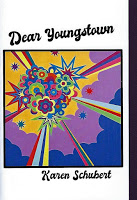
Accents on Books: Dear Youngstown: A Love Letter Home

Dear Youngstown: A Love Letter Home

The poems in Karen Schubert’s Dear Youngstown are deeply rooted in a sense of place, and brimming with animated detail: they might be stamped on the city’s concrete sidewalks, leading the reader on a guided tour of its neighborhoods and landmarks.

Through the poet’s plain-spoken narratives, we enter the atmosphere of the Old Ward Bakery with its “filmy windows stuck shut;” every sense responds to “rat-tail beets, blueberries, basil, muffins and tie-dye” mingled with “jazz, sultry” and banter at “Farmer’s Market.” 

The poet’s affection and concern for her adopted  hometown resonate throughout. We raise a glass at Cedars in “Closing the Bar,” pass an abandoned house with “swayback porch roof/gutters choke and hatch saplings,” in a row of homes slated for razing in “kitty corner from the empty high school.” 

Dear Youngstown is a wonderfully crafted love letter to the beautiful grit of a city on its knees, but rising.

DEAR YOUNGSTOWN
41 pps
retail price $15.00
ISBN #978-1-64092-999-9
Night Ballet Press, February, 2019


Barbara Sabol

Barbara Sabol is the author of the poetry collection, Solitary Spin, and two chapbooks, Original Ruse and The distance Between Blues. Barbara’s awards include an Individual Excellence Award from the Ohio Arts Council and the Mary Jean Irion Poetry Prize. She reviews poetry books for the blog, Poetry Matters.

ACCENTS POETRY CRAFT SERIES

ACCENTS POETRY CRAFT SERIES

We’re very happy to start offering live online craft sessions. We intend for these to deliver brief but powerful bursts of energy and inspiration on interesting topics. The sessions are accessible to anyone with a device such as a computer or smartphone and an internet connection.

The sessions are taught by Katerina Stoykova, owner and senior editor of Accents Publishing.

Every Monday 6:00-7:15pm
Sign up a-la-carte for $25.00 a session, or all 5 for $20 each.

Topics:
11/11 Developing a brilliant voice
11/18 Writing very short poems
11/25 Quotes, conversations and scenes in poetry
12/2 Arranging and titling a poetry manuscript
12/9 Submitting your work — pitfalls and strategies

Write to accents.publishing@gmail.com to reserve your spot.

Depending on interest/requests, local people may meet face-to-face.

Online Workshop Opportunity

Accents Publishing is offering a two-hour online workshop taught by owner and Senior Editor Katerina Stoykova. The topic is “Developing Your Poetry Collection: From Concept to Publication”. Description below.

Sunday, 10th of November, 2-4pm.
$40.00
Write to accents.publishing@gmail.com to reserve your spot.

Before you get up in front of an audience and read from your book, both you and your manuscript go through various stages. This workshop is designed to provide an insight to the considerations and skills necessary to successfully complete each stage and move on to the next. Be ready to learn what to expect, and hear tips on how not to get stuck, how to recognize if you’re making progress, how to make sure you’re focusing on what you have control over, how to keep yourself motivated through all this, and more.

“Ars Poetica” by Patty Paine

The dark beyond the window is
not the same as the dark inside

a piano, a dark you can’t know,
just as your body, sitting there

beside the piano, is an enclosure
with its own unknowable dark.

This is metaphor
for nothing. Just as a bird is not

a conceit, no matter how hard we want
to feel wings open

across our backs, taste flight
on our tongues. Even in death

a bird is not a blade that cuts
to the quick of our loss, it’s just

a splayed thing, something to be
stepped around, for decomposition to have

its efficient way, I don’t mean
to be cynical, but there are days

when language is heavy
furniture you push around

a house made of nothing
but hallways. I’m not feeling

sorry for myself, if that’s what
you’re thinking. I just want

you to be careful, because
sometimes a poem can lie.

It can make you think darkness
is a curtain that can be swept

back to reveal a sky gilded in light,
where wing beats fall

into a rhythm of hope, hope, hope.

-Patty Paine,
The Sounding Machine, 2012 © Accents Publishing

Patty PainePatty Paine is the author of Feral (Imaginary Friend Press), Elegy & Collapse (Finishing Line Press), and co-editor of Gathering the Tide: An Anthology of Contemporary Arabian Gulf Poetry (Garnet Publishing & Ithaca Press). Her poems, reviews, and interviews have appeared in Blackbird: an online journal of literature and the arts, The Atlanta Review, Gulf Stream, The Journal and many other publications. She is the founding editor of Diode Poetry Journal, and is an assistant professor of English at Virginia Commonwealth University Qatar where she teaches writing and literature, and is assistant director of Liberal Arts & Sciences.