Open Accents at Third Street Stuff aka Big Bad Community Open Mic

Dear Friends,

It’s time to emerge with poetry and books. Accents and Third Street Stuff invite you to an Open House and Open Mic on Saturday, the 23rd of April from 4pm to 7pm.

From 4pm to 5pm – browse books, drink coffee, hang out and catch up.

from 5pm to whenever – everyone is welcome to read a poem.

After the reading – hang out some more.

If the weather is nice, we’ll be outside. A few Accents authors will be in attendance to sign books.

We look forward to spending time together!

Announcing the Inaugural Local Accent Poetry Contest

Announcing the Inaugural Local Accent Poetry Contest

Prize

The winner will receive $100.00. The winning poem will be published on the Accents Publishing Blog and the author will be interviewed on the Accents YouTube channel. A list of the finalists may be posted and celebrated, as well.

Eligibility

Kentucky residents and those with strong ties to the state are welcome to submit.

Price for participation

None.

How to submit

Email one unpublished poem of any length or style along with a bio of fifty words to accents.publishing@gmail.com. Note that only the winner and the finalists will be contacted about the results.

Deadline

Poems must be received by the 30th of April, the end of National Poetry Month.

Judging and results

Judging will be performed by the Accents Publishing staff and the results will be announced in May.

Updates and Announcements from Accents Publishing

Dear Friends and Fans of Accents Publishing,

Happy Spring! In Kentucky we’re starting to see new leaves on trees. We spent a busy and productive winter and can’t wait to tell you about our latest accomplishments, opportunities and announcements. Please, read on.


New Book

Novella Contest Results

Literary Accents Update

Poetry Class and Manuscript Analysis Workshop


New Book

We’re very excited to present Christopher McCurry’s first full-length poetry collection, Open Burning.  It’s a gorgeous hardcover volume, and the poems detail the fallout of a young couple’s divorce. Click on the title to read a sample poem and to learn more about the book and the author. To browse our catalog, please click here.


Novella Contest Results

Accents Publishing is proud to announce the results of its Inaugural Novella Competition!

The winning novella is Homegoing, by Toni Ann Johnson!

Toni Ann Johnson will receive the $500.00 award and publication of her manuscript in a separate book volume. Those who have purchased in advance a copy of the winning novella will receive it as soon as the book is out.

We read many wonderful submissions and selected the following manuscripts as finalists:

Under the Seal, by Carol Mauriello

A Hollow, Muscular Organ, by Meg Files

Cheeseburgers, by Dean Crawford

City of Foam, by Ryan Slater

Moonlit Landing, by Ari McKenna

Things Are Not So Ill as They Might Have Been, by Scott Winokur

Accents Publishing is offering publication to the first three of these finalists.

Tremendous gratitude to everyone who sent manuscripts for consideration. We appreciate your trust and support. Please keep in touch. We hope to read your work again in the future.


Literary Accents Call for submissions

We’re still finishing up Issue #3 of Literary Accents. We hope to be able to send it to the printer within weeks.

We’re still reading submissions for Issue #4. The theme of Issue #4 is “breakup and heartbreak”. Send 3 – 5 poems to accents.publishing@gmail.com by April 30th. We look forward to reading your work.


Poetry Class

Katerina Stoykova (Owner and Senior Editor of Accents Publishing) is seeking eight to ten committed poets for a fast-paced six-week writing class in person or online. In each session, the poets will workshop a poem, then listen to a craft lecture and/or participate in a writing exercise. March 26th to April 23rd. Thursdays, 6 – 8 pm at The Pam Miller Downtown Arts Center. Price for the six-week class: $120. To reserve your space in the class, write to accents.publishing@gmail.com. Deadline to apply: March 16th


Manuscript Analysis Workshop and a Poetry Class

Looking for 4 – 5 poets with nearly-ready book-length manuscripts for a weekend-long manuscript analysis workshop lead by Katerina Stoykova (Owner and Senior Editor of Accents). You can participate in person or remotely via Skype. Price: $250. For more information or to reserve your spot, please write to accents.publishing@gmail.com. Exact dates TBD based on participant availability.  Deadline to apply: March 31st


Thank you, everyone, for reading to the very end of this email. We appreciate you! Best wishes from the team at Accents Publishing.


Exciting Opportunities for Learning

Accents Publishing School of Unlimited Learning


Poetry Class

Katerina Stoykova is seeking eight to ten committed poets for a fast-paced six-week writing class. In each session, the poets will workshop a poem, then listen to a craft lecture and/or participate in a writing exercise.

March 26th to April 23rd. Thursdays, 6-8pm at The Pam Miller Downtown Arts Center.

Price for the six-week class: $120

To reserve your space in the class, write to accents.publishing@gmail.com.

Deadline to apply: March 16th


Manuscript Analysis Workshop

Katerina Stoykova is seeking four poets with nearly-ready book-length manuscripts for a weekend-long manuscript analysis workshop. Each participant will read and comment on everyone else’s manuscript and receive feedback from all participants and the workshop leader.

April 18th and 19th. 2-6pm at The Pam Miller Downtown Arts Center.

Price $250.

For more information or to reserve your spot, write to accents.publishing@gmail.com.

Deadline to apply: March 31st


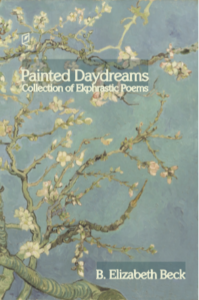
Painted Daydreams (Accents Publishing, 2019)

Poet B. Elizabeth Beck answers questions about Painted Daydreams (Accents Publishing, 2019)

Tell us the story of your Accents Publishing book. 

This book took ten years to research and write. I have studied and taught Art History for years, so this was a natural book for me to write. Art is my passion. To combine everything I love was a joy.


Do you still like it? Why or why not? 

I do still like it and am especially proud of the research notes included at the back of the book. Of course, I cannot take credit for the perfect formatting of those notes. Jay McCoy is such a good friend. He organized that work for me because he’s kind and generous and knows how to do these things correctly”.


What is the highest praise you’ve received for it? 

Matt Hart, a professor at the Art Academy in Cincinnati called my poems, “formally diverse and kaleidoscopically (allusionistically!) rich ekphrastic poems.” I consider that high praise!


What didn’t make it in the book? 

Interestingly, every poem that isn’t in this book didn’t make it. What I mean is that I wrote this collection while I was writing my first two books which were NOT art history books. Painted Daydreams was my escape while I was writing about very difficult poems. This was my book of joy.


Is there a poem from the book you’d like to share with the readers of the Accents blog?


In ancient Greece, Sophists


measure the existence of truth

as individual not universal; not absolute

Aristotle’s father and my grandfather

both physicians, yet Plato’s student blessed

with orphanage, blasphemous words

unless spoken by an insignificant girl.

I do not have the Oedipus privilege of gouging

my eyes I need to read Aristotle’s writings

on nature making him the world’s first scientist


when I am the last to understand and only learned

through Whitman’s leaves of grass transcendental

truth. I revere martyrs like Socrates executed

for corrupting youth and Holden Caulfield whose

merry-go-round Odyssean journey searching

an oracle in Phoebe futile; although the sentiment


appreciated as I practice Plato’s philosophy

of aesthetics, a branch he invented I teach

as an excuse to day dream in paintings

drenched in exuberance Van Gogh graces

the pages of the art history text I leaf ahead

(abandon Doric, Ionic, Corinthian) to look

at starry nights and potato eaters, again.


How did you arrive at the title? 

The title evolved from what I call Van Gogh’s paintings. I have been daydreaming in his art since I was seven years old.


Do you have a favorite Accents Publishing book (other than yours) and if so, which one? 

My favorite Accent Publishing book is “The Occupation” by Jay McCoy. His poems are stunningly brilliant.


What would you like to see Accents do going forward? 

Please continue to publish these beautiful books. Most importantly, please continue fostering writers. Without Poezia, I would never have published. I have learned so much about writing from being part of the Accents Publishing family.


What are you working on now?

I have just finished writing a novel about a young man named Sam who meets a group of kids and goes on tour with Phish. The working title is “Summer Tour”.


Share a poem, or at least a sentence from your new writing. 

“We were a new generation of seekers, intent in preserving the beauty of freedom from the Grateful Dead culture into a new evolution. Where it would lead was yet to be found, a fact that incited pure adrenaline; anticipation to join in what would be a remarkable slice of reality shaped between a guitar, bass, keys and drums performed by four ordinary dudes with extraordinary ideas. The fact that this tribe had found me and dragged me into this journey seemed destined. I couldn’t wait to swim among the sea of thousands of other like-minded people. I was ready for all things.”

Andrew Merton’s Poetry Collections

Poet Andrew Merton answers questions about his Accents Publishing collections. 


Tell us the story of your Accents Publishing books.

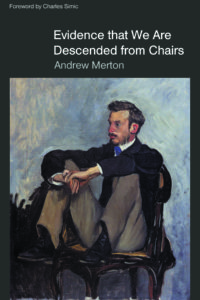
Early in 2011 Katerina published four of my poems in Bigger Than They Appear: Anthology of Very Short Poems. Emboldened, I sent her the manuscript of what would become my first book, Evidence that We Are Descended from Chairs.  We corresponded for several months, she saying she liked the manuscript but was not sure she was in a position to publish it.  Then, on May 12, my 67th birthday, she called and said it was a go.  That remains the best birthday present I have ever received.  Accents has since published my second and third books of poems: Lost and Found (2016) and Final Exam (2019).


Do you still like them? Why or why not?

Yes, I like them all.  The first one retains a special place in my heart because 1) My colleague and mentor Charles Simic generously wrote the foreword and 2) although previously I had published poems in journals, I did not fully identify as a poet until Chairs was out there in the world.


What is the highest praise you’ve received for your published books?

The New Hampshire Writers’ Project named it their outstanding book of poetry for the years 2012-2013.


What didn’t make it in the book?

Lots of really bad poems.


Is there a poem from the book you’d like to share with the readers of the Accents blog?


Why I Left The Poetry Reading Early


I wanted to applaud

after the very first poem,

in which the famous poet


revealed the secrets of the universe

and the human soul

with no more effort than a shrug.


The second poem put the first to shame.

I was forced to restrain myself

by gripping the edges of my chair


and sitting on my thumbs.

Soon it took all my resolve

to keep from shouting “Bravo”


after nearly every line.

Five more minutes of this

and nothing would have stopped me


from rising, unbidden,

and burbling superlatives.

So I left.


As I tiptoed down the hall

I thought I heard the famous poet say:

“Now we can really begin.”


How did you arrive at the title?

Many years ago—just as I was getting serious about writing poetry—Mark Strand, then at the peak of his fame as a poet, gave reading at UNH, where I taught, that blew me away.  The idea for the poem occurred to me as I listened to him read.


Do you have a favorite Accents Publishing book (other than yours) and if so, which one?

A Brief Natural History of an American Girl by Sarah Freligh.


What would you like to see Accents do going forward?

If Accents continues to evolve as it has over its first decade I’ll be very happy.


What are you working on now?

More poems. (Okay, my most recent book has a kind of elegiac title, Final Exam, but who knows, maybe I’ve got another one left in me.  Possible title: Post Doc.


Share a poem, or at least a sentence from your new writing.

This one appeared in the American Journal of Nursing, September, 2019.


Transcendence


It comes every month or so

while I am shaving


or peeling a potato

or watching a woodpecker


hammer away at an old dead pine:

shimmering blues, greens, yellows,


a rainbow effect

suffusing whatever is before me


with an otherworldly aura.

Doctors say these episodes


are manifestations of migraine.

The bird and I know better.

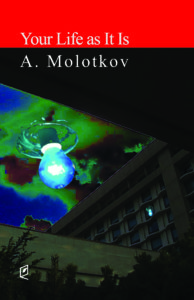
Your Live as It Is (Accents Publishing, 2014)

Poet A. Molotkov answers a few questions about Your Live as It Is (Accents Publishing, 2014) 

Tell us the story of your Accents Publishing book.

“Your Life As It Is” arose from the perception that most of our lives consist of similar repeating building blocks: we go to sleep, we wake up, we form relationships, we suffer loss. I was interested in creating a series that would play with these recurring themes. I started it before a trip to Russia my partner Laurie and I took in 2011. (Russia, the former USSR, is a country where I was born and which I hate intensely.) As we travelled, I tried to write a page or two each day, incorporating small details from the lives of the strangers we ran into. To further enhance the interplay of possibilities, I added a layer in which chess figures appear as characters.


Do you still like it? Why or why not?

Yes, I’m still fond of it. I think it captured what I wanted it to capture, and readers seemed to appreciate it.


What is the highest praise you’ve received for it?

I received an Oregon Literary Fellowship based on the submission of this poem. It ended up becoming the final work in my first full-length collection, “The Catalog of Broken Things” (Airlie Press, 2016).


What didn’t make it in the book?

Everything made it. I wanted the book to represent a generic life most generically.


Is there a poem from the book you’d like to share with the readers of the Accents blog?

The book is a single poem, so I’ll share a page:


You wake up in the morning. The clouds outside your window are strangely immobile, as if they were painted on the glass. Perhaps the wind is still asleep. You realize it would be nice to do something meaningful today, but no specific ideas come to mind.


Your husband’s car is still in the driveway. You are surprised he has not left for work. It’s not like him. You walk out into the living room and find him resting on your beautiful hardwood floor. You don’t feel anything at the thought of his absence.


Your skin is a reflection of your attempts to get closer to the true meaning of your life, but you suspect that it might be inside out. The bishop has given up faith and no longer finds satisfaction in diagonal existence. You remember your own memories better than your past.


You walk outside and find yourself on another street, next to another house. You might have been a different person all along, or perhaps there is a better explanation for all of this.


How did you arrive at the title?

I suppose there is some irony in it. “You” are the character in the book, and to state that “you” represents the reader is both correct and preposterous.


Do you have a favorite Accents Publishing book (other than yours) and if so, which one?

I need to read more of Accents Publishing books, but currently, “Grief & Other Animals” by Patty Paine is my favorite. It’s been a few years since I read it, but I was moved by its handling of grief. It’s a powerful collection.


What would you like to see Accents do going forward?

I feel that the press’s focus is very keen and necessary. Maybe Accents would be interested in publishing full-length poetry collections?


What are you working on now?

I’m always jotting down poems and editing new ones. Recently, I completed a memoir, “A Broken Russia Inside Me”, about my years in the USSR and my immigration. My agent is trying to sell it as I work on my next novel, about hate crime in America. (My previous two novels are unpublished so far, but my agent is working on that as well; I keep my fingers crossed.)


Share a poem, or at least a sentence from your new writing.

This poem was just published by Salamander. It was written in memory of the Portland poet Sam Seskin and titled with a quote from his poem. Many in the Oregon poetry community knew Sam; he was an inspiration. Sam’s first encounter with cancer six years earlier nearly ended his life and allowed him to view the extra time and his impending death with serenity and wisdom. The Inflectionist Review, a small press I co-edit with my friend John Sibley Williams, published his final collection of poems, “To Have Been Snowed On”.


Breath’s Opinion


                                                in memory of Sam Seskin


All I know is: at this

moment, a young scholar solves


a century-old problem. A group of six

climbs Everest, a group of twelve


is rescued from a hurricane. The same

smile faces us in the mirror after


all these years, but we are

so much smarter, so


lovingly open. And just now,

the doctor is born who will


cure everything that ails us, in

other patients. Easy now, don’t


be sad, small engine. There is too much

breathing left to do.


Orion’s Belt at the End of the Drive (Accents Publishing, 2019)

Poet Pat Williams Owen answers a few questions about Orion’s Belt at the End of the Drive (Accents Publishing, 2019)


Do you still like your book? Why or why not?

I still like Orion’s Belt at the End of the Drive. I’m proud of the poems and the period of my life it portrays. It’s honest and heart-felt and represents several years of conscientious work.


What is the highest praise you’ve received for it?

The highest praise I’ve received from it was from my granddaughter who said she loves it, that it made her laugh and cry.


What didn’t make it in the book?

What didn’t make it into the book were poems of lesser quality and those that didn’t fit thematically.


Is there a poem from the book you’d like to share with the readers of the Accents blog?

I’d like to share “After My Untimely Death” as a sample of a list poem that any writer can model.


After My Untimely Death

Sometimes as I leave the house
I foresee people coming in and finding
remains of my life spread out like the ruins
of Pompeii. For sure on the floor
my Birkenstocks, well-worn and embedded
with my DNA, journals, books and magazines
stacked by my chair, yesterday’s running shoes
beneath the table, shoe strings dangling
toothbrush standing at attention, maybe the towel
still damp, a coffee cup with the final dregs,
today’s New York Times spread out,
half read.

Did I leave a light still burning,
awaiting my return? The chairs
around the table askew,
a life in process, my fuzzy lap
blanket still on the footstool,
housing my sloughed -off cells
hiding out in the folds of the yarn,
fingerprints on the sliding door
belong to this particular life.

Thoughts and dreams religiously recorded,
black ink in journal after journal,
stacks of them. Shelves of books
underlined and notated, my sweat
smudged on each page. Light streams
in through the blinds as usual.

Funny, all the years of viewing Orion’s belt,
I thought my place on earth
was permanent.


How did you arrive at the title?

The title is taken from one of the poems in the book. In my poetry I try to address the intersection between the mundane and the transcendent. This poem is a metaphor for that.


Do you have a favorite Accents Publishing book (other than yours) and if so, which one?

My favorite Accents book other than mine is Katerina’s The Porcupine of Mind.


What are you working on now?

I’m working on new poems, observations of life as it passes.


Share a poem, or at least a sentence from your new writing.

Last Wash for the Old Car

To honor our 30 years of caretaking
I take my place in line with all the others
seeking purification,

that one moment of perfection
when the grey face of the car emerges
shiny dripping wet through the soapy steam.

Blue-shirted, brown-skinned workers
white towels wrapped round their heads
embrace it with rags

scrubbing until all surfaces shine.
I climb into the leather seat one last time,
fresh lemon scent surrounds me.


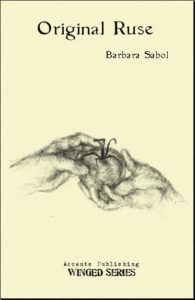
Original Ruse (Accents Publishing, 2010)

Poet Barbara Sabol answers questions about Original Ruse (Accents Publishing, 2010).
Tell us the story of your Accents Publishing book(s).

I submitted the chap manuscript for Original Ruse during a “Winged Series” chapbook competition in 2011. The book was chosen as a semi-finalist, I believe, with your offer to publish it. I was just finishing up my MFA at Spalding University, and taking myself seriously as a poet; or should I say taking the presence and power of poetry in my life seriously. The prospect of having my first collection in print was  an absolute thrill. It really is a legitimizing experience when an admired publisher offers to make a book of your poetry!  


Do you still like it? Why or why not?

 Yes, very much! It’s especially special because it was “my first.” I’m still fond of many of those poems; a few have made an appearance in my first full-length book, and two others landed in this forthcoming book, Imagine a Town. Of course, it’s nearly impossible to read poems that you wrote years ago and not want to revise most of them! Also, the book is lovely―perfect bound with Simeon’s original art on the cover. In fact, I still read from it at readings, and continue to sell copies.


What is the highest praise you’ve received for it?

In his jacket comment, Greg Pape  noted that the poems “explore connections between art and survival, the ordinary and the mythic. . .” Those tensions were exactly what I was aiming for, and what I continue to explore. To me, the highest praise is that of a reader who really grasps your themes and meanings.


What didn’t make it in the book?

I don’t think any poems were cut. I have a faint recollection of you questioning the inclusion of one or two of the poems, but at that point in my writing, I was too attached to each of my “darlings,” and resisted. I’m now much more willing to let a poem go if it doesn’t cohere with the whole. 


Is there a poem from the book you’d like to share with the readers of the Accents blog?

Yes. The closing poem, “Happiness.” I sometimes close a reading with this one, as happiness is a note I like end on in any context.

the mouth

of the vase

is not calling out


for asters

for water

its cobalt glass


curves

around the notion

of flowers


a quenched stem

and window light

scattering


the blueness


How did you arrive at the title?

It’s taken from the title poem, which I thought had an enticing ring to it. It’s what I want in a title and in poetry: to be enticed.


Do you have a favorite Accents Publishing book (other than yours) and if so, which one?

It’s difficult to name a favorite from among the terrific Accents books through the years. I actually have two favorites, equally favored but for different reasons. The first is Biblia Pauperum, by T. Crunk, because these spare poems  both challenge on an intellectual level and charm on a visual and emotional level―a wonderful combination.  And I’m completely enamored with Kingdom of Speculation by Barbara Goldberg. The element of magical lyric rendered in very sophisticated story book fashion completely engaged me. Plus, both books are physically beautiful.


What would you like to see Accents do going forward?

Accents has grown so much since its inception – going from chapbooks to full-length books. I love that the press has now extended to include a literary magazine, and a wonderful one, at that. Two areas that appeal to me as a reader, that broaden the scope and service of a journal: book reviews and essays. There is no shortage of new books to be reviewed, and book reviewers are always looking for journals to place their reviews. Literary Accents  could be such a place.

 Anthologies also make for another really engaging read. It’s always so interesting to read the variety of voices and forms on a given theme in an anthology. The Accents anthologies have been terrific, and I’d love to see more in the future.


What are you working on now?

I’m wrapping up the edits for my second full-length book, which will be out later this month from Sheila-Na-Gig Editions, titled Imagine a Town. As you well know, putting the finishing touches on a book is both a painstaking and exciting enterprise. So that’s consumed my time and attention these past months.

I am also well underway with my next book, a collection of persona poems in the voices of victims, both identified and “Unknown,”  of the  Johnstown  flood of 1889. An archival treasure trove has been made available to me by the Flood Museum and the National Park Service; I drew my characters from the original morgue book . This may sound like a depressing project, but not so! From the snippets of description in the morgue tome, whole characters can be concocted and reanimated.  I’m especially drawn to the “unknown” victims, of whom there were an estimated 2,200―people never claimed or properly mourned. The end of the 19th century was a true crossroads, culturally and economically, with the beginnings of the industrial revolution, railroad travel, etc., so that sketching out the books’  figures in this historical context  makes for fascinating research and material.


Share a poem, or at least a sentence from your new writing.

Sure, gladly. From Imagine a Town, this poem, “Ode to the Big Dipper,” is, on one level, an elegy for the decrepit roller coaster in an abandoned amusement park near my home.


Ode to the Big Dipper


Slip with me, child, through the ragged

cyclone fence; the air here sparks.

Let’s walk by the feeble coaster

where the wind turns shrill.

Even the Silver Rocket in orbit

over Chippewa Lake was eclipsed

by the Dipper’s serpentine reach.


See how bindweed twines the latticed frame,

and dried thistle, iron weed scale the

corkscrew tracks that carried cars slow,

slow to the rise then

plunged―

unhinged our grip to level earth.

Now un-done by oaks that split

the crossties’ nails and bolts; that

collapse the rickety shell of a thrill

into the abandoned park’s understory.


O Dipper! Splintered bone heap

of reckless joy, wooden relic of amusement,

heart-in-the-throat conveyance, you are restored

in memory’s gyres. I am transported

to ten, trespassed here at your crumble foot;

behemoth, splayed to the sky, to your

namesake constellation, given over

to a sad gravity, you bow to the ground

of our daring, our once shudder.

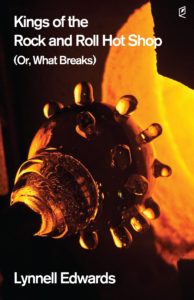
Kings of the Rock and Roll Hot Shop (Accents Publishing, 2014)

Poet Lynnell Edwards answers a few questions about Kings of the Rock and Roll Hot Shop (Accents Publishing, 2014)

Tell us the story of your Accents Publishing book.

I was teaching an ekphrastic community workshop for Louisville Literary Arts and we visited Flame Run studio where I had made a contact with the owner/artist Brook White. I wrote a short poem myself (below) during the workshop, and I was so taken by the process that I decided to ask him if I could install myself as a kind of poet-in-residence during that summer of 2010. I hoped to just watch and ask questions and write and see what happened. It was an exhilarating project that resulted in a chapbook-length manuscript which I kind of sat on for a while because I knew that my third full length book for Red Hen, Covet, was due out in the fall of 2011 and I didn’t want to crowd that publication release. There were a few of the poems published, so I had the sense that it was good work that would appeal to a wider audience even though the subject was a little bit technical and obscure (which is why there are some end notes explaining vocabulary). In fall 2013, I began the conversation with Accents about this manuscript and was delighted they were interested in the project! We had a really fun launch for the book at Flame Run after its release in June 2014 and the book got some nice coverage in the Courier-Journal.


Do you still like it? Why or why not?

I loooove this book. I love chapbooks generally, but I am really happy with the way I experimented in the book (there are a couple of shaped poems) and the liberating effect of having all kinds of new vocabulary from glass blowing at my disposal.


What is the highest praise you’ve received for it?

People have enjoyed this book and informally told me how intriguing and energy-filled it is. But perhaps the highest praise has come from Brook’s own endorsement of it and his sharing of the book among his friends, family, and the shop.


What didn’t make it in the book?

I think there were probably a couple of poems that I started but never really finished and I honestly can’t remember what they were. But there was one longer piece that I really worked on and wanted to make fit but didn’t which was about another glass blowing team that came in after hours to work – Brooke had invited them to use his studio. It was fascinating to watch them – in part because there was a whole different vibe – but strangely, I couldn’t make the poem quite cohere and it seemed out of step with the other poems. At that point, then, I realized that the poems I had been writing and the book they would become was as much about the spirit and work of a particular studio and its particular personalities as it was about glass blowing generally.


Is there a poem from the book you’d like to share with the readers of the Accents blog?

This is the first poem I wrote, after my initial visit to the studio, and it ended up as the final poem of the book:


“Heart of Glass”

Feel its pulse and flare still —
beat of primitive fire, memory
of the molten womb from which
you drew it glowing and gave it
shaping breath: never
cold, never still.


How did you arrive at the title?

“Kings of the Rock and Roll Hot Shop” came to me really early on and there were no other competing or working titles. Simply put, the glass blowing crew played loud rock music all the while they were working and there was such confidence and verve in what they were doing that it seemed obvious to me that this was a rock and roll hot shop.


Do you have a favorite Accents Publishing book (other than yours) and if so, which one?

I selected E.K. Mortenson’s The Fifteenth Station for the 2012 chapbook prize and I still think it’s a remarkable sequence imagining, with a nod toward the biblical, the “least of us” and the struggle in dark places we in the first world too often turn from. I also really like Sarah Freligh’s A Brief Natural History of an American Girl – an inventive and clear-eyed memoir in poems that startles and delights.


What would you like to see Accents do going forward?

Keep publishing awesome books, for one! The new projects – the journal, the workshop series – all of these things help to nurture writers and readers and I am excited to see them succeed. I’m interested in the ways in which fine art and writing mutually resonate and it would be interesting to see some manuscript collaborations among poets, printmakers, and other artists.


What are you working on now?

I have another chapbook length manuscript titled This Great Green Valley that will be published by Broadstone Books in the late spring of this year. It consists of poems I wrote during a sabbatical in 2018 and is based on my research at the Filson Historical Society into the pre-statehood history of Kentucky, along with a long poem about my own childhood on the Kentucky River. Red Hen has a full-length manuscript from me tentatively titled The Bearable Slant of Light that will likely be released in late 2021; it explores the explores the effects of mental illness on the family and is much more experimental in many ways. Very different from my last book with them, Covet.


Share a poem, or at least a sentence from your new writing.

This is the very last stanza from a very, very new poem titled: “Carpool, with boys”

“Remember where we were going and how
we couldn’t wait to get there: the impossibly
green fields, the bright lines of play, the whistle
to begin high and bright as birds lifting in flight.”