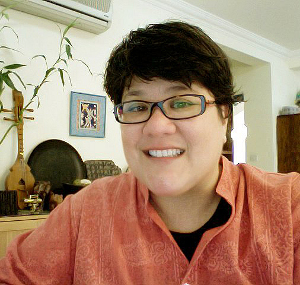
Poet J. Kates answers a few questions about Metes and Bounds (Accents Publishing, 2010)
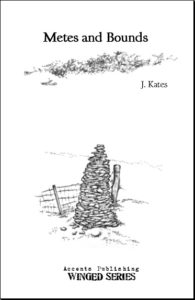
Tell us the story of your Accents Publishing book.
Not sure there is a story to tell. I had written some poems, they seemed to fit together in theme, there was a chapbook contest from Accents Publishing, and I submitted to it. You liked it, apparently.
Do you still like it? Why or why not?
The poems I write that stand the editorial test of time long enough to make it to publication are poems I like. The rest, I throw away.
What is the highest praise you’ve received for it?
Not sure I’ve received any “praise” for Metes and Bounds. You published it, some people have bought it. That’s praise. Can’t recall if it was ever reviewed.
What didn’t make it in the book?
Most of the poems I’ve written in my life. Luckily, a good many have made it into other books, with, I hope, more still to come.
Is there a poem from the book you’d like to share with the readers of the Accents blog?
I’d like to have your readers read them all. That’s why I wrote them. If it’s your blog, you choose.
Selected by Katerina and inserted in the text:
DOING THE WORMS’ WORK
The first April I am certain I will die,
the ground too cold, too wet for planting,
the river only a foot down from flood,
the compost heap a contradance of bees,
I need to be looking toward a harvest.
I will turn dirt. Without stooping
to pick rocks, I do the worms’ work
for an hour or two, see how I like it,
see how I enjoy the company of worms.
Not bad, they say, not bad for a beginner .
How did you arrive at the title?
Ah, there’s an interesting question. In New England, where I live, it has long been customary to establish boundaries not by formal surveying, but by noting and describing landmarks (or by creating them, as with walls and cairns). All the poems in this little collection somehow have to do with limits and limitations, and there is a rural cast to them; it seemed an appropriate title. I have worried, since, however, that the title sounds a little too bucolic, characterizing my work (unfairly, I hope) as “when the Frost is on the bumpkin.” Perhaps that’s balanced by the cosmopolitanism of an earlier chapbook (Mappemonde, Oyster River Press) and by other published poems.
Do you have a favorite Accents Publishing book (other than yours) and if so, which one?
Partial to anthologies and to translation as I am, you can guess I’d single out The Season of Delicate Hunger, for its introduction and presentation of contemporary Bulgarian poets.
What would you like to see Accents do going forward?
Succeed. On your own terms.
What are you working on now?
I have two full-length manuscripts being widely rejected. I continue to write — including some experimental, urban prose poems — and to translate.
Share a poem, or at least a sentence from your new writing.
“The human in me knows how to retreat.”