
Poet Barbara Sabol answers questions about Original Ruse (Accents Publishing, 2010).
Tell us the story of your Accents Publishing book(s).
I submitted the chap manuscript for Original Ruse during a “Winged Series” chapbook competition in 2011. The book was chosen as a semi-finalist, I believe, with your offer to publish it. I was just finishing up my MFA at Spalding University, and taking myself seriously as a poet; or should I say taking the presence and power of poetry in my life seriously. The prospect of having my first collection in print was an absolute thrill. It really is a legitimizing experience when an admired publisher offers to make a book of your poetry!
Do you still like it? Why or why not?
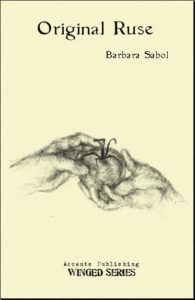
Yes, very much! It’s especially special because it was “my first.” I’m still fond of many of those poems; a few have made an appearance in my first full-length book, and two others landed in this forthcoming book, Imagine a Town. Of course, it’s nearly impossible to read poems that you wrote years ago and not want to revise most of them! Also, the book is lovely―perfect bound with Simeon’s original art on the cover. In fact, I still read from it at readings, and continue to sell copies.
What is the highest praise you’ve received for it?
In his jacket comment, Greg Pape noted that the poems “explore connections between art and survival, the ordinary and the mythic. . .” Those tensions were exactly what I was aiming for, and what I continue to explore. To me, the highest praise is that of a reader who really grasps your themes and meanings.
What didn’t make it in the book?
I don’t think any poems were cut. I have a faint recollection of you questioning the inclusion of one or two of the poems, but at that point in my writing, I was too attached to each of my “darlings,” and resisted. I’m now much more willing to let a poem go if it doesn’t cohere with the whole.
Is there a poem from the book you’d like to share with the readers of the Accents blog?
Yes. The closing poem, “Happiness.” I sometimes close a reading with this one, as happiness is a note I like end on in any context.
the mouth
of the vase
is not calling out
for asters
for water
its cobalt glass
curves
around the notion
of flowers
a quenched stem
and window light
scattering
the blueness
How did you arrive at the title?
It’s taken from the title poem, which I thought had an enticing ring to it. It’s what I want in a title and in poetry: to be enticed.
Do you have a favorite Accents Publishing book (other than yours) and if so, which one?
It’s difficult to name a favorite from among the terrific Accents books through the years. I actually have two favorites, equally favored but for different reasons. The first is Biblia Pauperum, by T. Crunk, because these spare poems both challenge on an intellectual level and charm on a visual and emotional level―a wonderful combination. And I’m completely enamored with Kingdom of Speculation by Barbara Goldberg. The element of magical lyric rendered in very sophisticated story book fashion completely engaged me. Plus, both books are physically beautiful.
What would you like to see Accents do going forward?
Accents has grown so much since its inception – going from chapbooks to full-length books. I love that the press has now extended to include a literary magazine, and a wonderful one, at that. Two areas that appeal to me as a reader, that broaden the scope and service of a journal: book reviews and essays. There is no shortage of new books to be reviewed, and book reviewers are always looking for journals to place their reviews. Literary Accents could be such a place.
Anthologies also make for another really engaging read. It’s always so interesting to read the variety of voices and forms on a given theme in an anthology. The Accents anthologies have been terrific, and I’d love to see more in the future.
What are you working on now?
I’m wrapping up the edits for my second full-length book, which will be out later this month from Sheila-Na-Gig Editions, titled Imagine a Town. As you well know, putting the finishing touches on a book is both a painstaking and exciting enterprise. So that’s consumed my time and attention these past months.
I am also well underway with my next book, a collection of persona poems in the voices of victims, both identified and “Unknown,” of the Johnstown flood of 1889. An archival treasure trove has been made available to me by the Flood Museum and the National Park Service; I drew my characters from the original morgue book . This may sound like a depressing project, but not so! From the snippets of description in the morgue tome, whole characters can be concocted and reanimated. I’m especially drawn to the “unknown” victims, of whom there were an estimated 2,200―people never claimed or properly mourned. The end of the 19th century was a true crossroads, culturally and economically, with the beginnings of the industrial revolution, railroad travel, etc., so that sketching out the books’ figures in this historical context makes for fascinating research and material.
Share a poem, or at least a sentence from your new writing.
Sure, gladly. From Imagine a Town, this poem, “Ode to the Big Dipper,” is, on one level, an elegy for the decrepit roller coaster in an abandoned amusement park near my home.
Ode to the Big Dipper
Slip with me, child, through the ragged
cyclone fence; the air here sparks.
Let’s walk by the feeble coaster
where the wind turns shrill.
Even the Silver Rocket in orbit
over Chippewa Lake was eclipsed
by the Dipper’s serpentine reach.
See how bindweed twines the latticed frame,
and dried thistle, iron weed scale the
corkscrew tracks that carried cars slow,
slow to the rise then
plunged―
unhinged our grip to level earth.
Now un-done by oaks that split
the crossties’ nails and bolts; that
collapse the rickety shell of a thrill
into the abandoned park’s understory.
O Dipper! Splintered bone heap
of reckless joy, wooden relic of amusement,
heart-in-the-throat conveyance, you are restored
in memory’s gyres. I am transported
to ten, trespassed here at your crumble foot;
behemoth, splayed to the sky, to your
namesake constellation, given over
to a sad gravity, you bow to the ground
of our daring, our once shudder.